
Hosted LLMs
Frontier open-weight LLMs, hosted on the OSRN
Free access for researchers and educators to a rotating catalog of frontier open-weight models — through a hosted chat interface, an OpenAI-compatible API, and ready-made configs for the major coding CLIs.
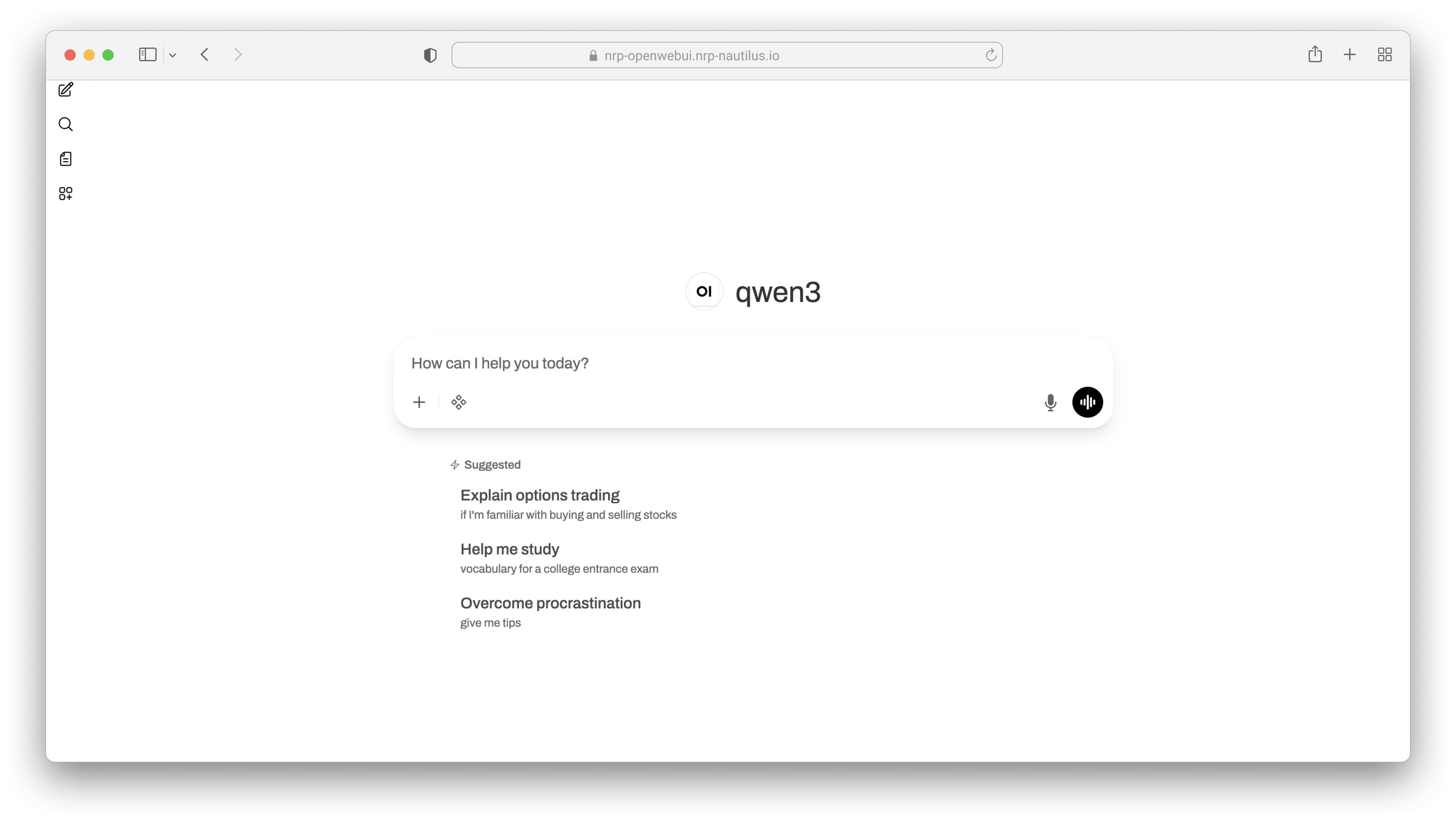
Three steps
How to get access
Step 1: Get an OSRN account
Sign in once with your institutional or research identity to register a OSRN account.
Step 2: Request an LLM-enabled namespace
Reach out and we will enable LLM access on your namespace so its members can mint tokens.
Step 3: Generate your LLM token
Use the token page to create a personal API token, then plug it into Open WebUI, Chatbox, or any OpenAI-compatible client.

Models we host
Frontier open-weight models with strong reasoning, coding, and multimodal capabilities. Pick the one that fits your task.
qwen3
Flagship frontier multimodal MoE — Claude/Gemini-level performance. Best for general reasoning, long-context work, and multimodal tasks.

kimi
Moonshot's 1T-parameter frontier coding model with multimodal inputs. Best for agentic coding workflows.

gemma
Google's Gemma 4 — multimodal, efficient frontier performance. A lighter-weight model that still handles images.

glm-5
Zhipu's 744B frontier coding model with NVFP4 weights. Strong on code and reasoning tasks.
minimax-m2
Efficient frontier coding model — 230B in native FP8, fits comfortably on four A100s.

gpt-oss
OpenAI's open-weights agentic model — tiny GPU footprint, strong tool use, LTS candidate.
Use the client you already love
Hosted chat interfaces, desktop apps, and coding CLIs all work with OSRN-hosted LLMs through the OpenAI-compatible endpoint.







How LLMs are being used on the OSRN
Researchers, educators, and OSRN operators are using hosted LLMs to analyze documents, build software, diagnose workloads, and understand platform usage.
OSRN infrastructure is connected to LLM-based tooling so operators can query and diagnose failing nodes using cluster context.
Users can diagnose problematic pods by inspecting logs, events, and related pod details through OSRN-assisted workflows.
Researchers can parse and summarize large document collections, then extract signals such as sentiment from sources like securities filings.
Classrooms and research groups can use coding agents with OSRN-hosted models to develop, review, and iterate on software projects.
OSRN develops MCP servers that plug into the OSRN accounting system to help teams understand platform usage and surface operational insights.
Ready to get started?
We will get you onto OSRN-hosted LLMs and answer any questions about access, namespaces, and tokens.